OEM Custom Steel Order Change Policy for Structural Pipes & Beams
Prevent profit erosion with our clear Custom Steel Order Change Policy for OEM structural steel orders. We define strict cut-off points for material and size adjustments, ensuring transparent fee calc...
OEM Custom Steel Order Change Policy for Structural Pipes & Beams
“Minor” specification tweaks are rarely free.
A clear, pre-defined Custom Steel Order Change Policy is the only way to prevent profit erosion and supply chain bottlenecks when adjusting OEM steel orders mid-production. This policy establishes strict cut-off points for material, size, and surface treatment changes, ensuring that both buyer schedules and manufacturer costs are protected through transparent fee calculations and formal documentation.
I still remember the silence on the other end of the line when a client from the Middle East asked to change H-beam lengths from 12 meters to 11.8 meters after the cutting schedule was already finalized. To them, it was a minor adjustment of twenty centimeters. To us, it meant scrapping an entire nested cutting plan, increasing scrap rates significantly, and delaying the shipment by weeks. The container had already arrived at the Qingdao port yard, and the request to switch surface treatment from shot blasting to hot-dip galvanizing post-production required returning the goods to the factory. The resulting demurrage, re-handling logistics, and rescheduling penalties ate up the entire margin of that order. That incident forced a complete overhaul of how we handle modifications. Now, every deviation from the Proforma Invoice requires a formal Change Order Request, with fees calculated based on administrative effort, material waste, and production disruption. [NEED_CITE: industry standard contract practices for manufacturing change orders]
Understanding these boundaries is critical for procurement managers and EPC firms who need clarity on flexibility versus cost. Let’s break down how a robust Custom Steel Order Change Policy works in practice.
Why Do Steel Orders Need Strict Change Policies?
Uncontrolled modifications create supply chain bottlenecks and cost disputes that jeopardize project timelines.
In structural steel manufacturing, production is not a linear assembly line but a complex interplay of raw material allocation, cutting optimization, and surface treatment scheduling. When a buyer assumes that “minor” changes are harmless, they often overlook the ripple effects on the entire production batch. A single change in length or grade can disrupt the nesting software used to minimize waste from steel plates or coils. [NEED_CITE: impact of cutting plan disruption on material yield]
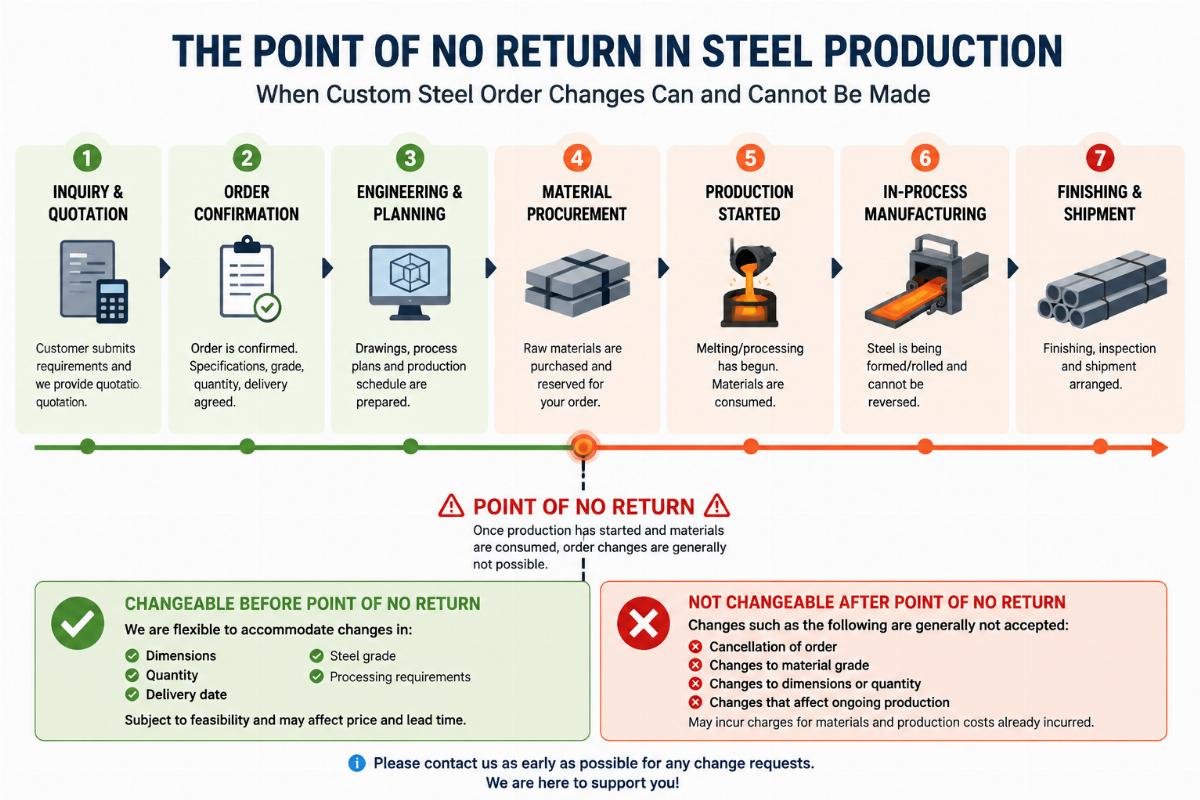
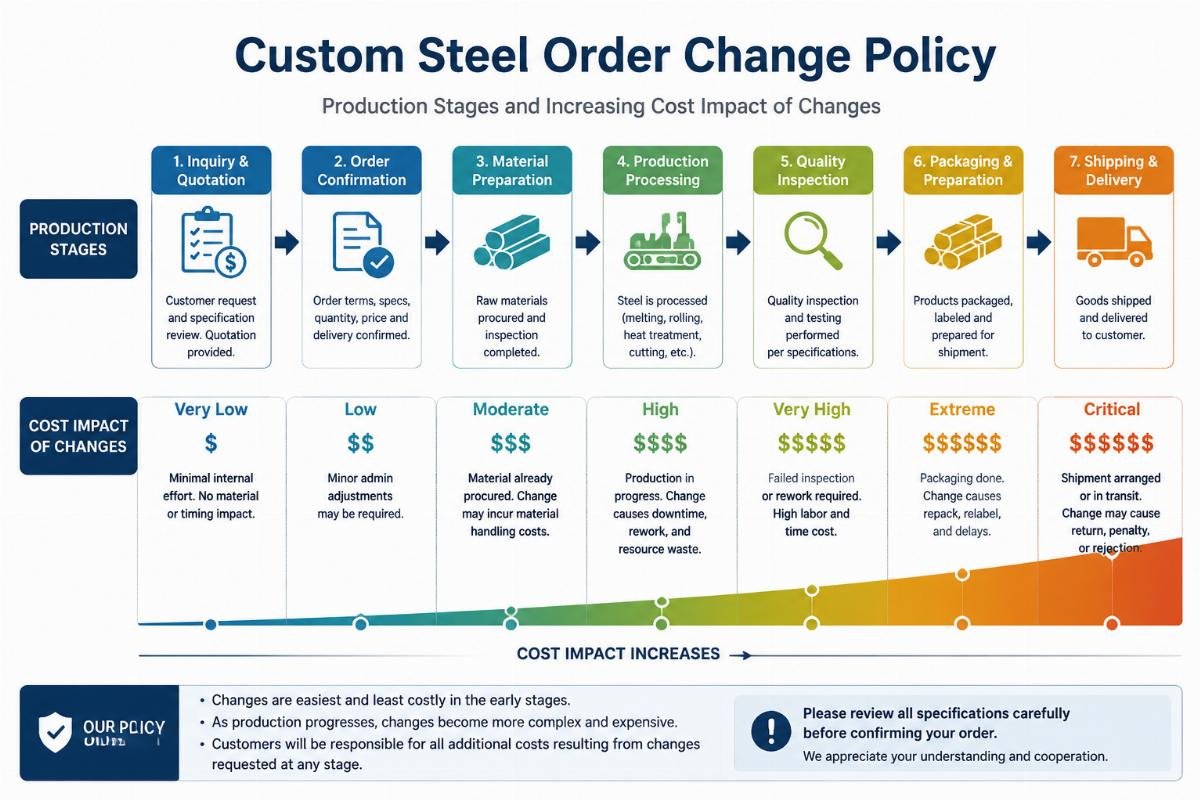
The core purpose of a Custom Steel Order Change Policy is to define the “Point of No Return.” Before raw material is allocated, changes are flexible. Once the steel is cut, welded, or treated, any modification becomes exponentially more expensive. Without a clear policy, manufacturers face the dilemma of absorbing costs or engaging in contentious negotiations, while buyers face unpredictable delays. By establishing strict rules upfront, both parties can budget accurately and avoid the shock of hidden fees later in the process.
What Changes Are Allowed Before Production Starts?
Material grade and quantity adjustments are flexible prior to raw material allocation, but require immediate confirmation.
Before the production clock starts, there is a window of opportunity for buyers to adjust their orders without incurring heavy penalties. This phase typically covers the period between the signing of the Proforma Invoice and the issuance of the material purchase requisition to the steel mill. During this time, the Custom Steel Order Change Policy allows for modifications to material grades, such as switching from Q235B to S355JR, or adjusting quantities to fit container loads more efficiently.
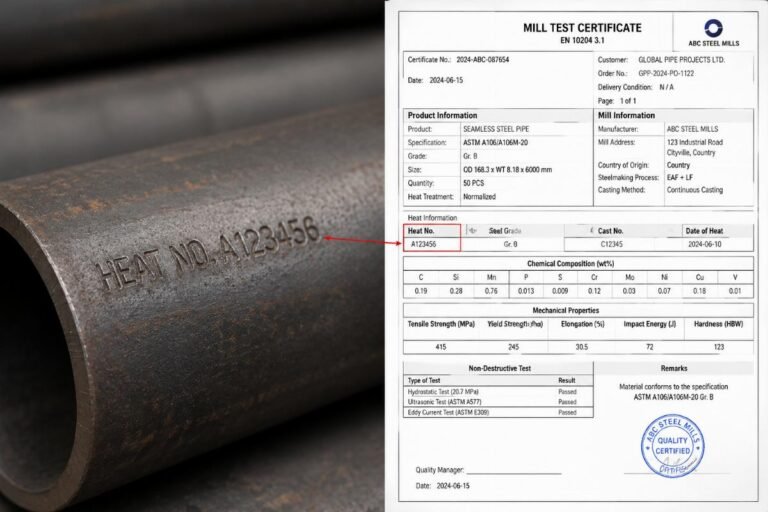
However, even in this early stage, changes are not without administrative overhead. A formal Change Order Request must be submitted to update the technical drawings and quality control plans. If the change involves a different steel grade that requires new Mill Test Certificates or third-party inspection protocols, the lead time may extend slightly. Buyers should note that while material costs might remain stable if market prices haven’t shifted, the administrative fee for reprocessing the order documentation still applies. This ensures that the engineering team has the correct specifications before any physical work begins. [NEED_CITE: documentation requirements for steel grade changes in export contracts]
What Happens If You Change Specs During Manufacturing?
Late changes incur waste fees and significant lead time delays due to disrupted production schedules.
Once production has commenced, the Custom Steel Order Change Policy shifts from flexibility to strict cost recovery. This is where most disputes arise. Consider the case of a European fabricator who requested a change in the surface treatment of structural pipes from sandblasting to painting after the blasting process was complete. This seemingly simple switch required the goods to be moved back into the factory, cleaned, and repainted, doubling the internal logistics handling.
Another common scenario involves length adjustments. If a buyer requests a change in H-beam length after the cutting schedule is finalized, the manufacturer cannot simply trim the existing pieces. The nested cutting plan, which optimizes material usage from large plates, is destroyed. The remaining offcuts may become scrap, leading to a material waste charge. Additionally, the production line must be stopped and rescheduled, causing a delay that affects not just the current order but potentially subsequent batches. [NEED_CITE: cost implications of production rescheduling in steel manufacturing]
Change Type
Production Stage
Impact Level
Typical Fee Components
Material Grade
Pre-Allocation
Low
Administrative Fee
Quantity Increase
Pre-Cutting
Medium
Material Cost + Admin Fee
Length Adjustment
Post-Cutting
High
Material Waste + Rescheduling Penalty
Surface Treatment
Post-Production
Critical
Double Handling Logistics + Rework Cost
These examples highlight why the Custom Steel Order Change Policy defines specific cut-off points. Understanding these stages helps buyers make informed decisions about when to lock in specifications.
How Are Change Order Fees Calculated?
Transparent breakdowns of administrative, material, and logistics costs help clients budget accurately for EN-standard structural steel projects.
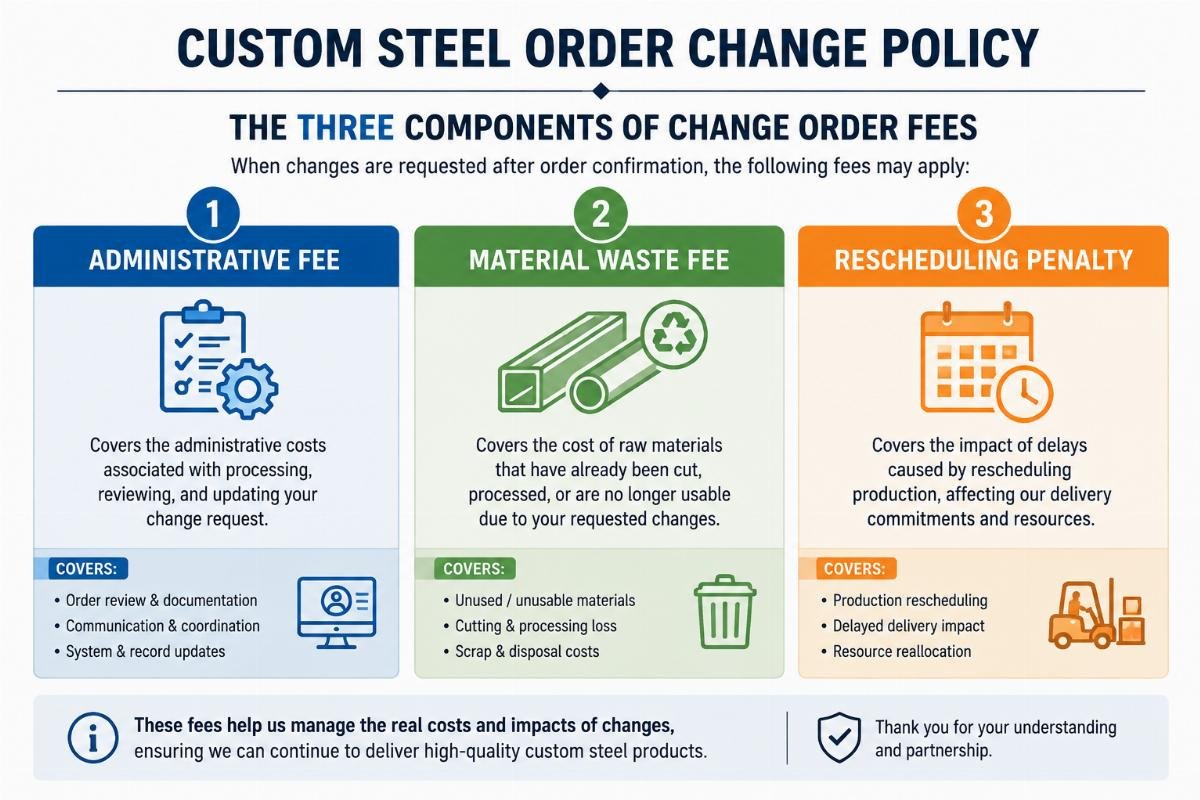
The fee structure under our Custom Steel Order Change Policy is designed to be transparent, avoiding hidden surprises. It typically consists of three main components: an administrative fee, a material waste cost, and a rescheduling penalty. The administrative fee covers the time spent by engineers and sales teams to update drawings, revise quality control plans, and issue new documentation. This is a fixed cost regardless of the order size.
The material waste cost is variable and depends on the stage of production. If raw material has already been cut, the buyer is charged for the scrap generated by the change. For example, if changing a beam length renders previously cut offcuts unusable, the full value of that wasted steel is passed on. The rescheduling penalty accounts for the disruption to the production line. In high-demand periods, this fee may be higher due to the opportunity cost of delaying other orders. [NEED_CITE: standard fee structures for manufacturing change orders]
By providing this detailed breakdown, Xin Jiyuan helps clients understand the true cost of flexibility. This transparency allows procurement managers to justify the expense to their stakeholders or decide whether the change is worth the delay and additional cost. It also encourages buyers to finalize specifications early, minimizing the need for costly changes later.
How to Submit a Valid Change Request?
Use standardized Change Order Request forms to ensure quick processing and accurate cost estimation.
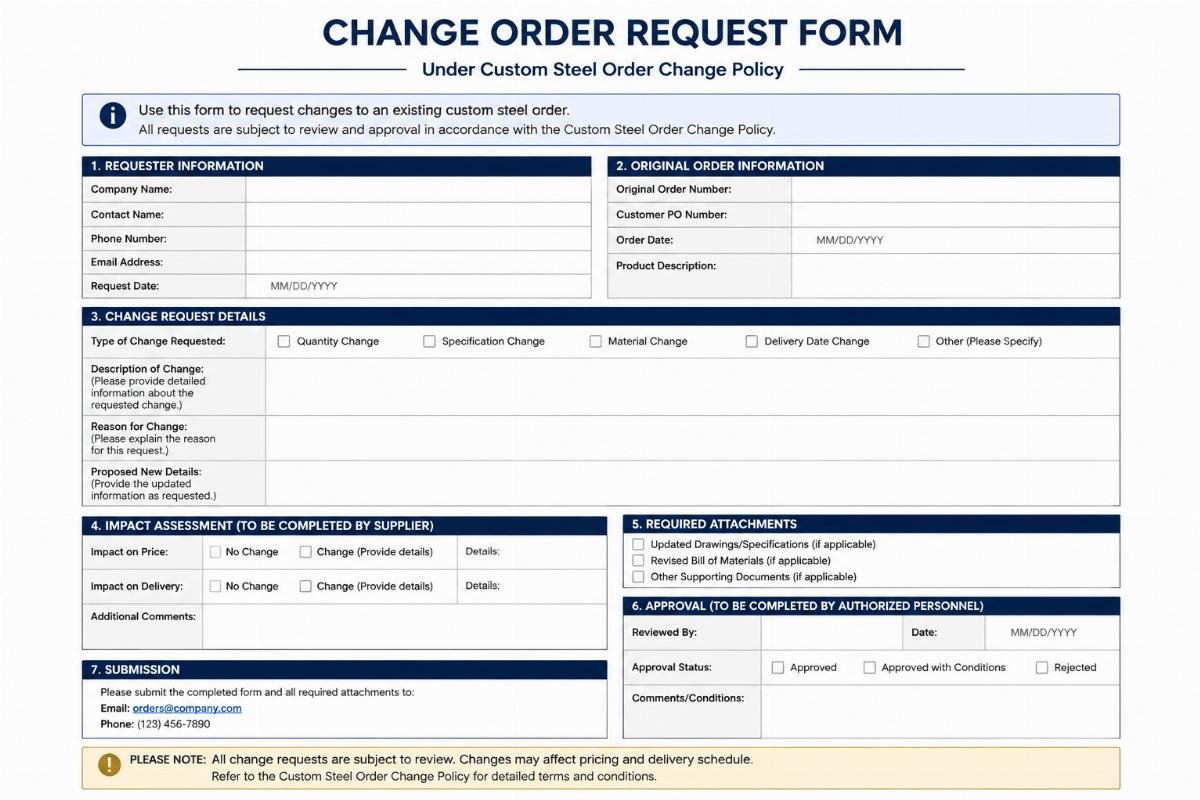
To initiate any modification, buyers must submit a formal Change Order Request (COR). This document serves as the official record of the requested change and triggers the evaluation process. The COR should include the original order number, the specific specification to be changed, the reason for the change, and the desired new specification. Vague requests like “make it shorter” are not accepted; precise measurements and technical details are required.
Upon receipt, the manufacturer’s engineering team evaluates the feasibility and cost impact. They then issue a revised quotation reflecting the additional fees and any changes to the delivery schedule. Only after the buyer approves and signs this revised quotation does the change become effective. This step is crucial for maintaining the integrity of the Custom Steel Order Change Policy. It ensures that both parties agree on the new terms before any work is done, preventing disputes later. [NEED_CITE: best practices for change order management in international trade]
Failure to follow this process may result in the original specifications being maintained, or worse, the change being implemented without proper cost recovery, leading to financial losses for the manufacturer. By adhering to this structured approach, buyers can ensure their requests are handled efficiently and professionally.
Conclusion
Clear policies prevent profit erosion and supply chain disruptions.
A well-defined Custom Steel Order Change Policy protects both buyers and manufacturers by setting clear expectations for modifications. By understanding the cut-off points and fee structures, procurement teams can make informed decisions that balance flexibility with cost efficiency. This approach minimizes disputes and ensures that structural steel projects stay on track and within budget.
Editor covering global sourcing, supplier verification, and industrial product knowledge. Content is compiled from manufacturer specifications, industry standards, and hands-on experience with international B2B buyers. Every article is fact-checked before publishing to help procurement professionals make informed decisions.




Discussion
0 Comments