Custom Structural Steel S355JR Q345B Manufacturer for Sale
Sourcing from a custom structural steel manufacturer China requires verifying grade authenticity to avoid port rejections. Learn to distinguish S355JR from Q345B and demand EN10219 certified documenta...
Lower price often means higher risk when the chemistry is wrong.
Sourcing custom structural steel from China requires verifying grade authenticity between S355JR and Q345B, ensuring dimensional precision for custom cuts, and demanding mill test certificate traceability that matches physical heat numbers. Buyers must prioritize third-party inspection readiness over initial unit cost to avoid port rejections. A custom structural steel manufacturer China partner is defined by their ability to provide EN10219 certified documentation and consistent mechanical properties, not just competitive FOB quotes.
I grew up near the steel mills in Jinan, spending my early career in quality control labs staring at spectrometers and tensile testing machines before moving into international trade. The shift in perspective was immediate: buyers rarely fear the price; they fear the disconnect between the paper certificate and the physical cargo arriving at their port. A few years ago, a client in the Middle East ordered a batch of square hollow sections specified as S355JR from a local trader. Upon arrival at Jebel Ali port, the SGS复检 (re-inspection) revealed yield strength levels comparable to S275, not the required S355. The entire container was stuck at the terminal, with demurrage costs eating up any initial savings. Since then, his first question to me is always whether the EN10219 certificate can withstand a third-party lab’s scrutiny. I confirm it can, because I track the heat numbers, chemical composition, and mechanical properties step by step from the furnace. You can smell the difference between legitimate production and material substitution.
The gap between expectation and reality in cross-border steel procurement usually stems from a lack of technical verification. Many importers assume all “structural steel” is interchangeable, but the specific requirements for load-bearing structures demand rigorous adherence to international standards. This guide breaks down how to navigate these complexities, focusing on the critical differences between European and Chinese grades, the importance of dimensional tolerances, and the documentation required for smooth customs clearance.
Why Do Custom Structural Steel Orders Fail Inspection?
Grade substitution and lack of traceability are the primary causes of inspection failure.
When a shipment fails at the destination port, it is rarely due to minor surface rust or packaging issues. The core issue is almost always a mismatch between the declared grade and the actual chemical or mechanical properties of the steel. In the context of working with a custom structural steel manufacturer China, this risk is amplified if the buyer relies solely on the supplier’s self-issued certificate without independent verification protocols.
The most common pitfall is the substitution of lower-grade materials. For instance, a supplier might deliver Q235B material while labeling it as Q345B or S355JR. Visually, these steels look identical. However, their yield strengths differ significantly. Q235B has a yield strength of approximately 235 MPa, while Q345B and S355JR require minimums of 345 MPa and 355 MPa, respectively. Using the wrong grade in a high-load structure like a bridge or multi-story warehouse can lead to catastrophic failure. [NEED_CITE: mechanical property requirements for structural steel grades]
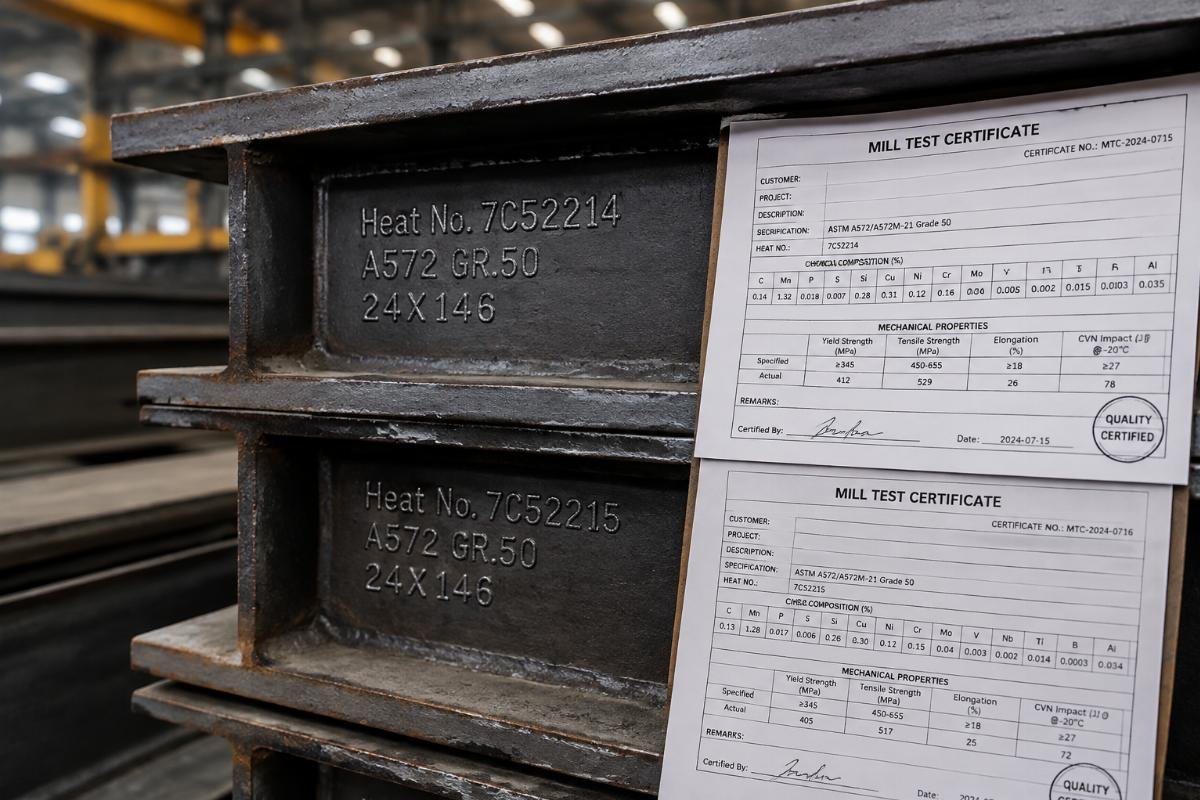
Another frequent issue is the lack of heat number traceability. Each batch of steel produced in a mill is assigned a unique heat number. This number links the physical product to its specific chemical analysis and mechanical test results. If the heat numbers stamped on the steel beams or pipes do not match the numbers on the Mill Test Certificate (MTC), the documentation is invalid. Customs authorities and third-party inspectors like SGS or Bureau Veritas will reject the shipment immediately.
Failure Mode
Root Cause
Consequence
Grade Substitution
Supplier uses lower-cost steel (e.g., Q235 instead of S355JR)
Documentation does not align with physical markings
Customs rejection; inability to verify origin
Non-Compliant Chemistry
Carbon or manganese levels outside standard limits
Poor weldability; increased brittleness
Lack of EN Certification
Product manufactured to GB standard only, not EN10219
Rejection in EU-regulated projects
A practical example involves a fabrication shop in Southeast Asia that received a mixed container of H-beams and rectangular hollow sections. The surface treatment was inconsistent, with some pieces showing inadequate galvanizing thickness. While the steel grade was correct, the lack of uniform coating led to premature corrosion concerns. The delay in re-coating added nearly a week to the project timeline, disrupting the entire fabrication schedule. This highlights that quality control extends beyond just the base metal to include surface treatments and dimensional accuracy.
S355JR vs Q345B: Which Grade Fits Your Project?
S355JR and Q345B are not interchangeable due to different impact toughness and chemical composition requirements.
One of the most persistent misconceptions in the industry is that S355JR (European Standard) and Q345B (Chinese National Standard) are equivalent. While they share similar yield strength thresholds, their application scopes differ based on environmental conditions and regulatory requirements. Choosing the right grade is critical when sourcing from a custom structural steel manufacturer China, as it dictates the manufacturing process and certification needed.
S355JR is defined under EN 10025-2. The “JR” designation indicates that the material has been tested for impact resistance at room temperature (20°C). It is widely used in construction projects across Europe and regions that adopt EN standards. The chemical composition limits for carbon, manganese, and silicon are strictly controlled to ensure weldability and ductility. [NEED_CITE: EN 10025-2 chemical composition limits]
Q345B, defined under GB/T 1591, is the dominant structural steel grade in China. The “B” indicates impact testing at 20°C, similar to JR. However, the allowable ranges for certain alloying elements may differ slightly from EN standards. For projects in Africa or Asia where local regulations accept GB standards, Q345B is often a cost-effective choice. But for projects requiring CE marking or compliance with Eurocodes, S355JR is mandatory.
Parameter
S355JR (EN 10025-2)
Q345B (GB/T 1591)
Yield Strength (≤16mm)
≥355 MPa
≥345 MPa
Impact Test Temperature
20°C
20°C
Primary Standard
European Norm
Chinese National Standard
Typical Application
EU Construction, Bridges
Domestic China Infrastructure, Export to GB-accepting regions
Certification Requirement
EN10219 / EN10210
GB/T 1591
A case in point is an infrastructure project in Africa where Q345B plates were specified for bridge components. The design required custom cutting with a tolerance of ±1mm. While Q345B met the strength requirements, the manufacturer had to extend the lead time by two weeks to achieve the necessary precision machining, as standard stock items typically have looser tolerances. This extension was planned, but it underscores the need to clarify both grade and dimensional specs upfront.
For buyers in the Middle East or Europe, insisting on S355JR ensures compatibility with local engineering codes. When requesting quotes, specify the standard explicitly. A reputable custom structural steel manufacturer China will have separate production lines or quality control protocols for EN-standard products to ensure the chemistry meets the stricter European limits.
How to Verify a Chinese Manufacturer’s Quality Control?
Check for in-house laboratories, patent certificates, and specific EN10219 compliance capabilities.
Verifying the quality control (QC) capability of a supplier goes beyond asking for a brochure. It requires evidence of systematic testing and adherence to international standards. When evaluating a custom structural steel manufacturer China, look for tangible indicators of their technical infrastructure.
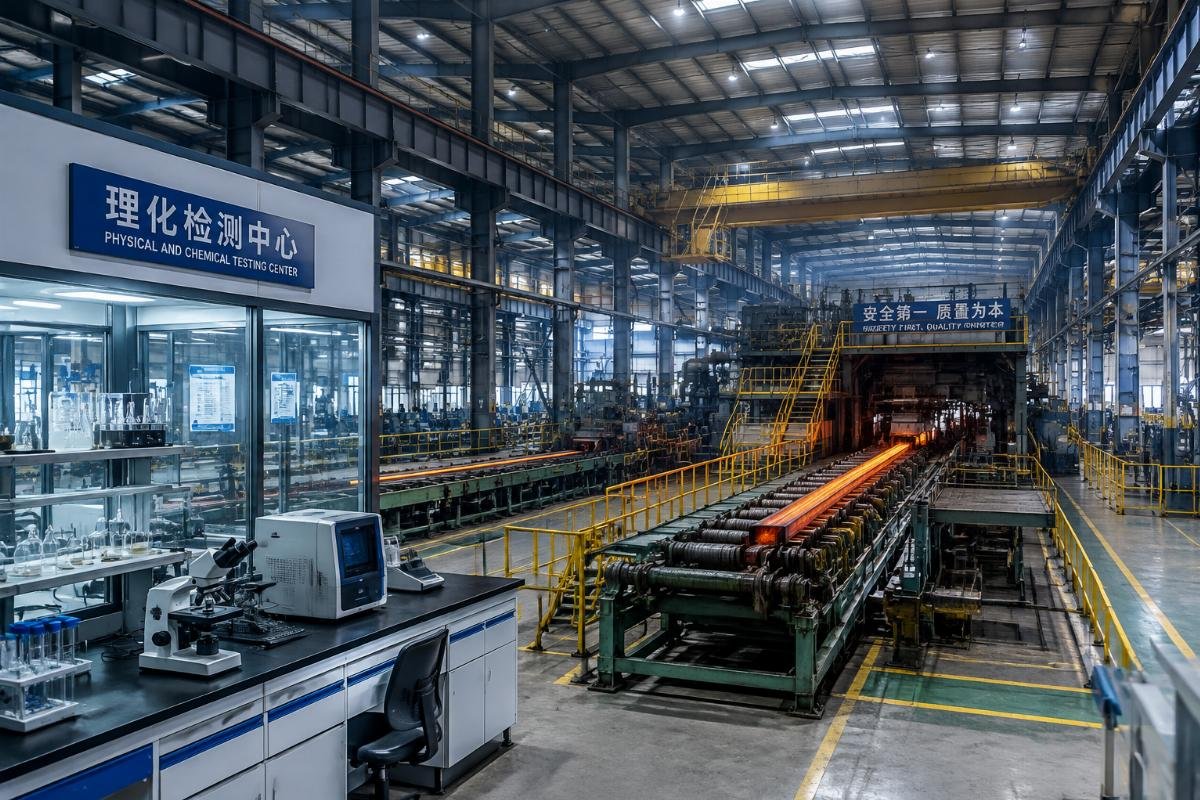
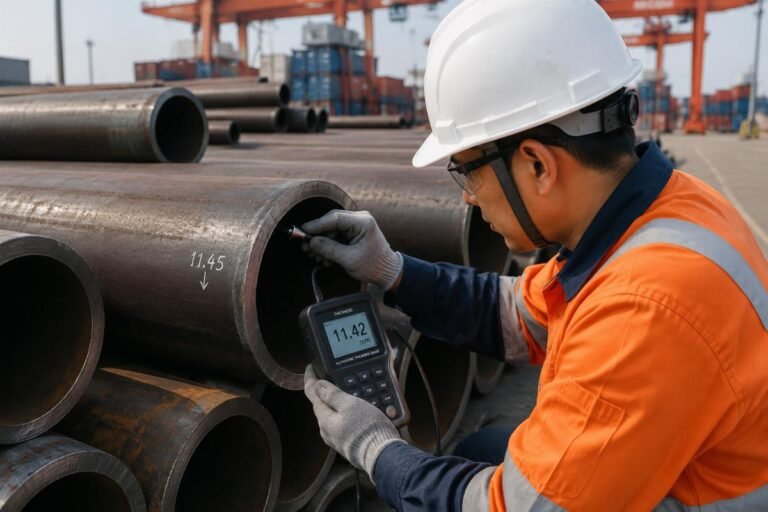
First, inquire about their in-house laboratory. A serious manufacturer will have equipment for spectral analysis (to check chemical composition) and tensile testing (to verify yield and tensile strength). Ask if they can provide raw data logs from these tests, not just the final certificate. The ability to produce internal test records demonstrates transparency. [NEED_CITE: importance of in-house testing for quality assurance]
Second, check for relevant certifications. EN10219 is the key standard for cold-formed welded structural hollow sections. EN10210 covers hot-finished hollow sections. Ensure the manufacturer holds valid certificates for these standards. Additionally, look for ISO 9001 certification, which indicates a managed quality system. However, ISO alone is not enough; it must be backed by product-specific certifications.
Third, review their patent certificates and technical achievements. While patents may seem unrelated to basic steel production, they often indicate investment in process improvement, such as better straightening techniques for beams or more uniform galvanizing processes. A manufacturer with multiple patents is likely more focused on technical excellence than simple trading.
Consider the example of a manufacturer with over twenty production lines and an integrated lab. Such a setup allows for real-time monitoring of production parameters. If a batch shows slight deviations in chemistry, the in-house lab can flag it before it proceeds to cutting or welding. This proactive approach prevents defective goods from ever leaving the factory, reducing the risk of disputes later.
What Documents Ensure Customs and Site Acceptance?
Mill Test Certificates with matching heat numbers are non-negotiable for customs and site acceptance.
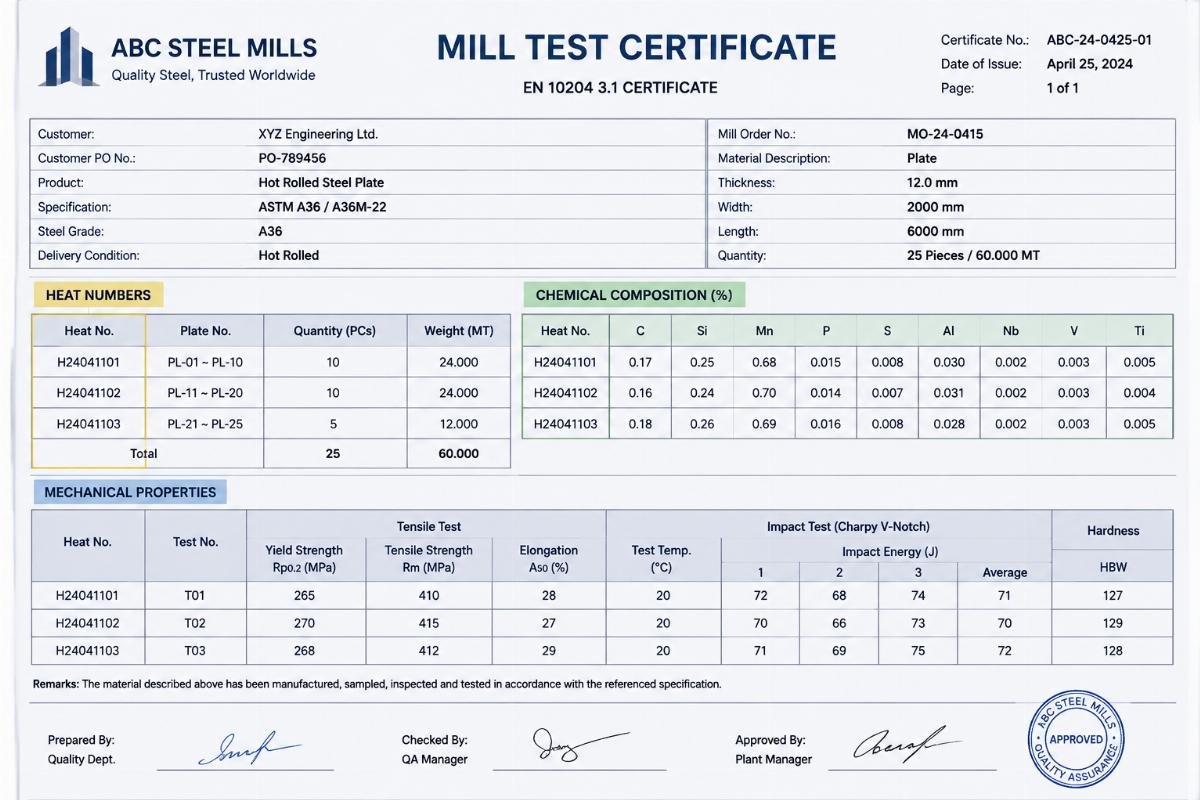
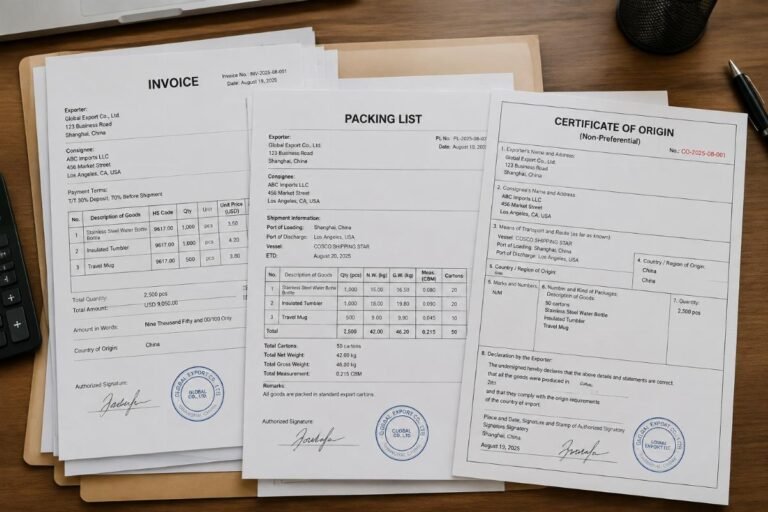
Documentation is the legal backbone of any steel transaction. Without the correct papers, even high-quality steel can be detained at customs or rejected by the site engineer. The most critical document is the Mill Test Certificate (MTC), also known as the EN 10204 3.1 or 3.2 certificate depending on the level of third-party involvement.
The MTC must include:
Heat Number: This unique identifier must be stamped on every piece of steel. Inspectors will randomly select pieces and cross-check the stamp against the certificate.
Chemical Composition: Detailed breakdown of Carbon (C), Manganese (Mn), Silicon (Si), Phosphorus (P), and Sulfur (S). These values must fall within the limits of the specified standard (e.g., S355JR).
Mechanical Properties: Yield strength, tensile strength, and elongation percentages. Impact energy values (Joules) at the specified temperature are also crucial for JR/J0/J2 grades.
Standard Reference: Clear statement of the standard used (e.g., EN 10219-1:2016).
For high-risk projects, buyers often require third-party inspection reports from agencies like SGS, Bureau Veritas, or Intertek. These reports validate the MTC data through independent testing. A custom structural steel manufacturer China experienced in exports will be familiar with these procedures and should welcome such inspections.
A common mistake is accepting a “Certificate of Conformity” issued by the trader instead of the original MTC from the mill. Always request the original mill certificate. If the supplier is a trader, they must provide the link to the original producer. Discrepancies in dates, heat numbers, or chemical values between the trader’s doc and the mill’s doc are red flags.
Conclusion
Successful sourcing hinges on verification, not just price negotiation.
Avoiding grade substitution and ensuring dimensional precision are the cornerstones of importing structural steel. By understanding the differences between S355JR and Q345B, verifying QC capabilities through in-house lab data, and demanding traceable Mill Test Certificates, buyers can mitigate the risks of port rejections. Partnering with a custom structural steel manufacturer China that prioritizes transparency and EN-standard compliance ensures that your construction projects proceed without costly delays.
Editor covering global sourcing, supplier verification, and industrial product knowledge. Content is compiled from manufacturer specifications, industry standards, and hands-on experience with international B2B buyers. Every article is fact-checked before publishing to help procurement professionals make informed decisions.




Discussion
0 Comments